

PSEO Coalition Annual Report 2025
The PSEO Coalition supports the growth, sustainability, and use of data to demonstrate how higher education can change a person’s life.


I consider 2025 to be a transformational year for the PSEO Coalition.
We created the systems and structures to engage our community in more holistic ways. We offered numerous opportunities for our members to learn from and interact with one another. We refreshed our look to give our Coalition a more cohesive feel. And we grew our membership faster than we have ever previously done.
I am honored to serve as the PSEO Coalition’s Director and to collaborate with so many of you as we leverage these powerful data to make decisions for our states, our systems and institutions, and, most importantly, for our current and future students.
As we look ahead to this Coalition’s future and the exciting opportunities that are already taking shape, I am incredibly optimistic about our shared ability to effect change.
In partnership,

When Dr. Stephanie Huie and I first began reaching out to the U.S. Census Bureau in 2012 to get access to data on where University of Texas System graduates were employed after completing their degrees, I never could have imagined the PSEO Coalition as it is today.
My mission to better understand postsecondary employment outcomes is now a thriving community that counts four-fifths of U.S. states among its membership.
Regardless of if we come from Hawai’i or Maine, or a large public institution or a small private college, we are all looking to understand the same question: What happens to students after they earn their credentials? While I am proud of how this Coalition has grown, I am rarely satisfied with the status quo. I know there is even more innovation out there to harness these data, along with many more members to make it robust.
I would like to especially encourage our members to take advantage of this community. There are collectively thousands of years of experience we have access to, and we are here to support one another every step of the way. I hope that everyone can find their place at the PSEO Coalition table.
Sincerely,
About the PSEO Coalition
The PSEO Coalition is a network of representatives from the institutions, college and university systems, and state agencies that partner with the U.S. Census to provide data for the PSEO project. Coalition members engage virtually and in-person to network and share ideas about methods to measure and share the outcomes of postsecondary education with decision-makers of all types.
Mission
The PSEO Coalition powers informed decisions through comprehensive, collaborative, and sustainable integration of nationwide postsecondary graduate outcomes data, driving strategic enhancements across educational and employment landscapes.

Our Vision
The PSEO Coalition supports the growth, sustainability, and use of data to demonstrate how higher education can change a person’s life.
2025 by the Numbers



+7 New Members from

Kansas

Maryland

North Carolina

Rhode Island

Tennessee

Washington, DC
Our Membership
- >75% Graduate Coverage
- 50% - 75% Graduate Coverage
- 25% - 49% Graduate Coverage
- <25% Graduate Coverage
- Data Pending
Events
Summit 2025

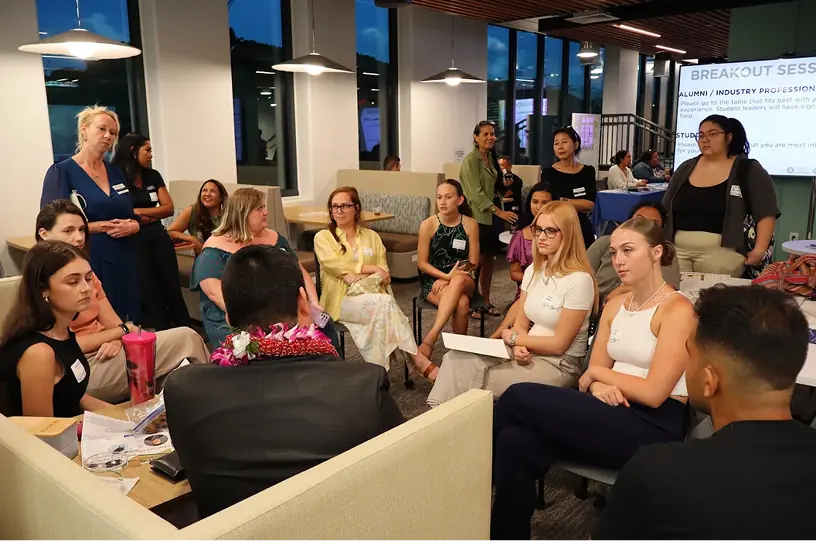
On April 30 and May 1, 2025, 130 postsecondary education and workforce development leaders from institutions, systems, and state agencies joined national experts on state data ecosystems to share promising practices and engage in dialogue around improving the collection and use of data to inform crucial decisions.



The Summit agenda was packed with opportunities for learning and networking. Sessions were designed to guide attendees through an intentional flow of learning opportunities:

As part of the PSEO Coalition’s engagement framework, the Summit built on monthly virtual meetings and learning opportunities by focusing on large- and small-group engagement to build attendees’ professional networks and knowledge related to education-to-employment data ecosystems.
Sessions included:
- An update from the U.S. Census Bureau on PSEO;
- State Opportunity Index Clear Outcomes Elements from Strada Education Foundation;
- Breakouts on topics such as utilizing PSEO and related data to inform audiences; and
- A panel discussion with career advising professionals on sharing employment outcomes insights with postsecondary students.

“I was able to talk with other state colleagues and share learnings of what has worked in our state (on a variety of topics). It’s very helpful to know that we don’t struggle with things alone, and we can lean on each other for help and wisdom.”

“This is probably my favorite and most useful conference that I go to.”
Summer Webinar Series
Our summer webinar series offered institutional researchers, state agency staff, and anyone interested in education-to-workforce data a chance to get to know and dive deeper into PSEO data. The three-part series introduced participants to the PSEO Explorer tool, discussed how to integrate the dataset with other data management and visualization tools, and explored how to use the data comprehensively with other supplementary data.
JUNE 2025
Getting Started with the PSEO Explorer: Navigating Postsecondary Employment Outcomes Data
At this webinar, participants learned how to use the PSEO Explorer tool to access valuable data on student outcomes. The webinar introduced the dataset, explained how institutional and U.S. Census Bureau data are integrated, and walked participants through downloading data in multiple formats.
JULY 2025
Using PSEO Data in Practice: Tools, Insights, and Key Considerations
This webinar allowed participants to take the next step with PSEO data by exploring how to apply it in real-world analysis. The webinar covered how to begin working with PSEO data in tools like Python, Tableau, and Power BI to answer common research questions. It also discussed important data nuances – such as the cohort model and how PSEO differs from other federal datasets – to help participants work with the data effectively and responsibly.
AUGUST 2025
Advanced PSEO Data Use: APIs and Data Integration for Deeper Analysis
In this advanced session, participants learned how to use the PSEO data programmatically using the API and how to enrich analysis by supplementing PSEO with other key datasets, including IPEDS survey data, U.S. Census earnings data, and cost of living indicators. This webinar was aimed at users looking to build custom workflows and perform more comprehensive, context-rich analyses using PSEO data.
Showcases
The PSEO Coalition hosted two virtual showcases to explore innovations, research, and best practices that are helping states and institutions enhance their education-to-workforce data systems.
~200
participants attended our virtual showcases
February 2025 Showcase
The February 2025 Virtual Showcase brought together institutional, system, state, and national postsecondary professionals focused on data collection and use to discuss and advance a more connected and robust education-to-workforce data ecosystem. We explored innovations and best practices that are helping states enhance their education-to-workforce data systems.
Session 1: Strengthening States’ Education-to-Workforce Data Ecosystem
- Welcome – Dr. Rachel Boon, Chief Academic Officer, Iowa Board of Regents
- Plenary – Dr. Ben Boggs, Commissioner of the Missouri Department of Higher Education & Workforce Development
- Orientation to the Showcase – Dr. Gina Johnson, Director, Postsecondary Employment Outcomes (PSEO) Coalition
Session 2: Demonstrating How Higher Education Can Positively Impact a Person’s Life
- Dr. Melissa Humphries, Assistant Commissioner of Data Management and Research, Texas Higher Education Coordinating Board
- Steve Rogness, Research Analyst, Minnesota Office of Higher Education
- Michael Vente, Chief Performance Officer, Colorado Department of Higher Education
September 2025 Showcase
The September 2025 virtual showcase featured the latest insights from our 2025 Research Grant recipients and highlighted new research and dashboards that advance our understanding of education-to-workforce outcomes using PSEO data.
Following a competitive call for proposals in winter 2025, the Coalition awarded five $15,000 grants to research teams exploring innovative ways to use PSEO data. The September showcase presented the results of these projects across two tracks – Research Reports and Dashboards.
All research and tools featured are available in the PSEO Coalition Resource Library.
Research Reports
- Exploring Outcomes in Education Fields
Allison C. Bell & Gina Johnson - Graduate Debt & Earnings
CJ Libassi & Julia Turner - Community College Baccalaureates
Riley Acton, Kalena Cortes, Lois Miller, Camila Morales & Julia Turner
Exploring Outcomes in Education Fields
Allison C. Bell & Gina Johnson
This report uses the Connective Data and Dashboard Strategy (CDDS) to demonstrate how the PSEO Explorer can answer questions about the earnings and geographic flow of graduates from baccalaureate education programs.
Community College Baccalaureates
Riley Acton, Kalena Cortes, Lois Miller, Camila Morales & Julia Turner
The first national analysis of labor outcomes for CCB graduates – mobility, industry match, and salary outcomes.
Graduate Debt & Earnings
CJ Libassi & Julia Turner
A new look at long-term earnings by debt load, degree type, and income percentile for doctoral programs of professional practice.
Dashboards
- Benchmarking Across Borders
Vladimir Bassis & Paula Nissen - Montana’s Education-Wage Link
Eric Meredith - Dashboards at Scale
University of Utah’s Analytics & Institutional Reporting Office
Benchmarking Across Borders
Vladimir Bassis & Paula Nissen
Iowa’s community college outcomes get a national comparison using enhanced PSEO data and regional adjustments.
Montana’s Education-Wage Link
Eric Meredith
A cross-sector analysis revealing the relationships between degrees, industries, and wages across Montana.
Dashboards at Scale
University of Utah’s Analytics & Institutional Reporting Office
Extending PSEO-powered dashboards to benchmark student outcomes across R1 and AAU institutions.
Operations
Growing Our Presence and Collaboration
Member Engagement
The PSEO Coalition broadly expanded offerings to members by providing numerous opportunities for engagement, learning, and networking. In addition to a summer webinar series and virtual showcases, we led monthly meetings for all Coalition members to share specific examples of PSEO data use and quarterly meetings connecting PSEO data providers with U.S. Census Longitudinal Employer-Household Dynamics (LEHD) colleagues to discuss enhancements to PSEO.
We also launched a member portal, which offers an “ask the community” discussion platform, member resources, and relevant announcements. More than 110 members joined the portal in 2025.
State Opportunity Index Clear Outcomes Technical Assistance
In partnership with Strada Education Foundation, the Coalition connected its members to technical assistance and resources focused on enhancement of self-selected outcomes connected to the State Opportunity Index. This work was designed to help members enhance their state education-to-workforce data ecosystems.
Postsecondary Value Framework Implementation Community
A set of 15 Coalition members applied to participate in coaching, technical assistance, and peer collaboration to assist them in implementing aspects of the Postsecondary Value Framework, improving their capacity to measure and report on the value of educational credentials at the institutional level.

Brand Growth
To better reflect PSEO Coalition’s membership and growth, we underwent a brand refresh. This work involved creating a new visual and written identity. The updated logo uses bright and professional colors and incorporates imagery of both graduation and data expansion.
As part of the refresh, we created a new PSEO Coalition website to better serve members and our broader community. The new site includes photos provided by coalition members; a filterable resource library with reports, dashboards, and more; and an interactive membership map.
To reach more members, we also launched a LinkedIn profile, which quickly gained more than 400 followers and has experienced high levels of engagement.
Coalition Committees
Research Committee
Our 2024-2025 Research Committee provided feedback to inform the PSEO Coalition’s research strategy and outreach. The Research Committee also reviewed applications for the PSEO Coalition research grants.
The Committee was comprised of five members representing state agencies, systems, and public and private colleges, along with an ex officio member from the U.S. Census Bureau, and we are grateful for their leadership.
- Stan Gladych, Colorado Department of Higher Education
- Stacy Karl, Minnesota State Colleges and Universities
- Sara Lazenby, University of Wisconsin-Madison
- Carrie Mayne, Utah System of Higher Education
- Megan Rozowski, Minnesota Private College Council
- Cody Orr, U.S. Census Bureau (ex officio)
- Gina Johnson, PSEO Coalition (ex officio)
Interactive Tools Committee
The Interactive Tools Committee provided ideas and feedback to inform the PSEO Coalition’s interactive tool development by student interns.
Members included representatives from state agencies and systems, plus ex officio members from Strada Education Foundation and the PSEO Coalition’s Student Intern Supervisor.
- Paula Bales, University of Texas System
- Benjamin Boer, Education Systems Center at Northern Illinois University
- Nicholas Gill, Maine Community College System
- Bryan Grady, South Carolina Department of Employment and Workforce
- Jason Pontius, Iowa Board of Regents
- Nathan Wilson, Illinois Community College Board
- Dana Brandt, Strada Education Foundation (ex officio)
- April Prak, Strada Education Foundation (ex officio)
- Christopher Peña, PSEO Coalition (ex officio)
- Gina Johnson, PSEO Coalition (ex officio)
Foundational Board Work
Annika Many, our Strategic Member Engagement Partner, guided the Board of Directors through the consideration of multiple organizational structure options. The Board worked with Ithaka S+R to develop a research agenda to expand the use of PSEO data. They also worked with the Gardner Institute to conduct scenario planning for PSEO data and the Coalition.
Research Grants
In spring 2025, after a review of responses to our call for proposals, the PSEO Coalition awarded five research grants of $15,000 each to support the following projects.
The results of these projects are available in the PSEO Coalition’s Resource Library.
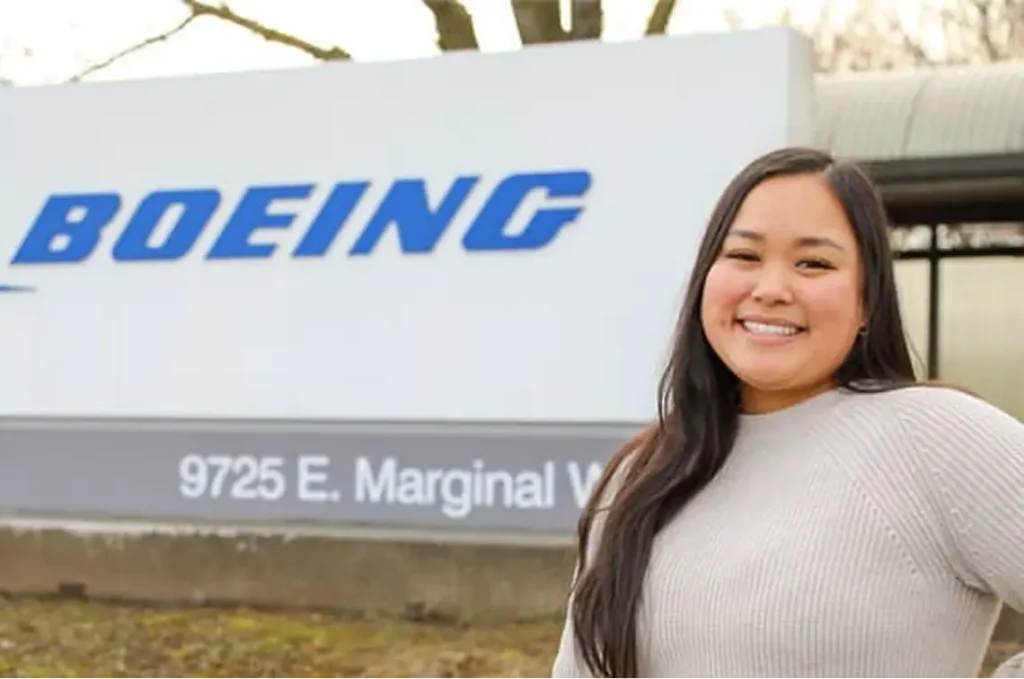
CJ Libassi and Julia Turner used PSEO data in combination with data on program-level graduate debt to better understand the relationship between debt and earnings for select doctoral programs of professional practice. Compared to existing work, this analysis looked at longer-run earnings for the full student population (both federally aided students and not) covered by PSEO and for more than just the typical earnings, taking advantage of PSEO’s data on earnings at the 25th and 75th percentiles for each program. This analysis allowed for a more complete picture of the value proposition of graduate school beyond the typical, short-term outcome for borrowers.

Eric Meredith analyzed PSEO data in combination with data from the Montana University System (MUS) and state-level wage information. His focus was on comparing educational outcomes across different degree levels, academic fields (as defined by two-digit CIP codes), institutions, NAICS (North American Industry Classification System) sectors, and geographic regions. By linking these data, the project answered important questions regarding how education correlates with employment outcomes and wages in Montana, providing valuable insights into the relationship between educational attainment and workforce readiness.

Riley Acton, Kalena Cortes, Lois Miller, Camila Morales, and Julia Turner studied community college baccalaureates. Their project used PSEO data, which covers 13 states offering community college bachelors’ degrees (CCB), to summarize earnings, geographic mobility, and industry match rates of graduates in the first comprehensive, national study of CCB graduate outcomes. Understanding the labor market outcomes of CCB graduates in relation to existing degree programs is providing preliminary insights into the success of these programs in expanding access to quality BA programs.

The University Analytics and Institutional Reporting Office at the University of Utah currently uses extensive PSEO data in various dashboards, including the “Post-Bachelor Dashboard” and “Student Success for Graduate Students Dashboard.” Through this project, they added PSEO data to allow comparisons against other R1 or AAU Universities. A broader comparison against regional and national peers has helped to understand the potential push and pull factors of an education at the University of Utah compared to the potential value of the same degree or program at a different university.

Vladimir Bassis and Paula Nissen used PSEO data to further develop the existing Iowa Department of Education employment outcomes research on cohorts of community college students. In this project, they used PSEO to benchmark and compare Iowan student outcomes to other states, combining PSEO data with data from other sources to adjust data for regional comparability.
Intern Projects
PSEO Coalition’s student data visualization interns from Northern Illinois University, DiviyaBharrathi Barathwaaj and Sai Teja Tadikonda, developed three interactive tools using PSEO data.
Developed under the guidance of Dr. Christopher Peña and in consultation with a volunteer committee of PSEO Coalition members, the tools are intended for use by Coalition members and the general public. Each tool is accompanied by information that allows users to better understand the tool and recreate it using their own set of PSEO data. The tools are followed by links to overviews that include an explanation of the intended audience, data sources, and uses for each tool, technical documentation, and videos demonstrating how to use the tool.
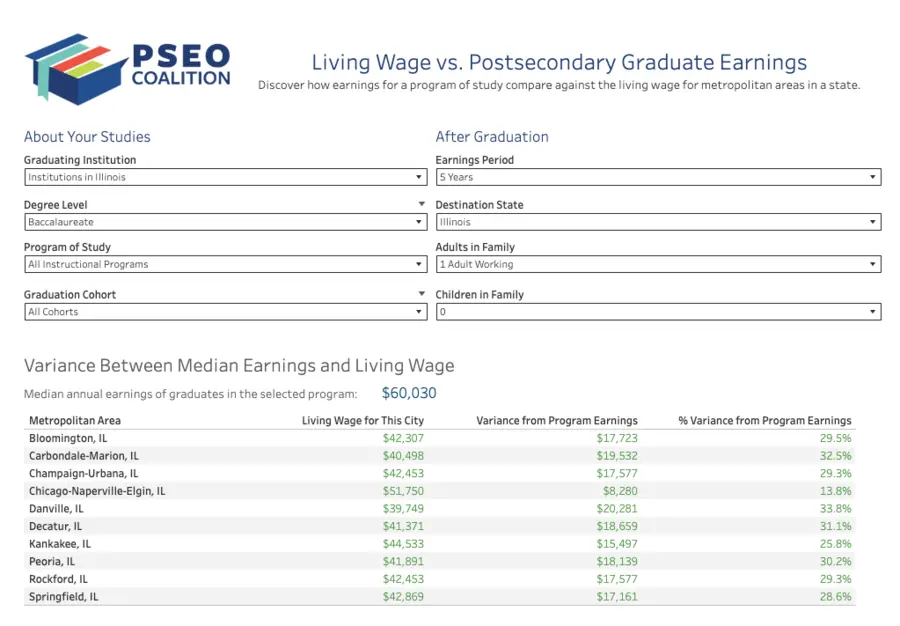
Living Wage vs Postsecondary Graduate Earnings
Compares the median annualized earnings of postsecondary graduates with the living wage in U.S. metropolitan areas to evaluate the economic viability of post-graduation outcomes, allowing users to select a state and view detailed data for its metro areas.

Postsecondary Earnings Comparison
Allows users to explore and compare the 25th, 50th (median), and 75th percentile of annualized earnings for college and university graduates by state, institution, program, and graduate cohort across PSEO-participating states.

Earnings by Educational Attainment
Allows users to compare the median annualized earnings of college graduates to those of high school graduates within a selected U.S. state.
Ithaka S+R Research
Elise Miller McNeely and Elizabeth Davidson Pisacreta from Ithaka S+R conducted an environmental scan to learn more about how researchers, state agencies, and institutions and systems have used PSEO data to share employment outcomes data. Findings include:
- PSEO data are used by institutions, systems, and state agencies in published postsecondary outcomes dashboards.
- Researchers have explored earnings and employment trends and institutional performance using PSEO data.
- PSEO data have been leveraged by graduate students and city leaders measuring the impacts of colleges and universities on the economy.
- Interstate migration and geographic mobility have also been explored by researchers utilizing the PSEO dataset.

Our People
2025 Board of Directors
- David Troutman, PhD
Board Chair
Deputy Commissioner for Academic Affairs, Texas Higher Education Coordinating Board - Rachel Boon, PhD
Board Vice Chair
Chief Academic Officer, Iowa Board of Regents - Angela Bell, PhD
Associate Vice Chancellor for Research and Policy Analysis, University System of Georgia - Colin Chellman, PhD
Senior University Dean for Applied Research, Evaluation, and Data Analytics
- Amy Cox, PhD
Director, Office of Research and Data, Oregon Higher Education Coordinating Commission - Bryan Grady, PhD
(Term began September 2025)
Assistant Executive Director for Labor Market Information, South Carolina Department of Employment and Workforce - Sara Lazenby, PhD
(Term began September 2025)
Director of Institutional Research Partnerships and External Engagement, University of Wisconsin-Madison - Tod Massa
(Term concluded September 2025)
Director of Policy Analytics, State Council of Higher Education for Virginia
2025 Strategic Partners
- Gina Johnson, PhD
PSEO Coalition Director
Principal & Co-founder, Data EmpowerED Consulting - Annika Many
Strategic Engagement Partner
President & CEO, EDU-PM - Christopher Peña, PhD
Data Literacy Partner & PSEO Coalition Intern Supervisor
Assistant Professor of the Practice, Department of Business Information and Analytics, University of Denver
- Jason Simon, PhD
Research & Leadership Partner
Independent Consultant, SCL Impact - Buoy Marketing
Strategic Communications Partner
Buoy Marketing - Allison Bell, PhD
(Project concluded June 2025)
Research Partner
Principal, Three Arrows Up Consulting
Fiscal Agent and Philanthropic Partners
Texas Higher Education Foundation
The Texas Higher Education Foundation (THEF), the official nonprofit partner of the Texas Higher Education Coordinating Board (THECB), serves as fiscal agent for the PSEO Coalition. The Coalition extends its appreciation for the THEF’s support, including the expertise, time, and resources its staff share to advance the work of the Coalition.


Strada Education Foundation
Strada Education Foundation sponsored PSEO Summit 2025, research projects and grants, internships, technical assistance opportunities focused on the State Opportunity Index Clear Outcomes, and administrative functions of the Coalition.
Gates Foundation
Gates Foundation provided funding for the Postsecondary Value Framework (PVF) Implementation Community of select Coalition members engaged in technical assistance and peer sharing focused on their implementation of the PVF. The foundation also funded administrative functions of the Coalition, expanding its network and reach.


Lumina Foundation
Lumina Foundation supported our Summit 2025 networking reception.
Join Us
The PSEO Coalition supports the growth, sustainability, and use of data to demonstrate how higher education can change a person's life. We welcome the education-to-employment community to utilize this high-quality dataset and engage with the PSEO Coalition through our virtual learning and research activities.
Explore PSEO Resources
Want to know how to better inform your constituencies about the value of the PSEO Explorer and membership in the Coalition?
Have a Question?
Have a question for our staff or board? We’re here to provide insights and support as we work together to shape the future of higher education.
Our People
Board of Directors:
David Troutman
Board Chair
Deputy Commissioner for Academic Affairs, Texas Higher Education Coordinating Board

Rachel Boon
Board Vice Chair
Chief Academic Officer, Iowa Board of Regents

Angela Bell
Associate Vice Chancellor for Research and Policy Analysis, University System of Georgia

Colin Chellman
Senior University Dean for Institutional Policy and Research, City University of New York

Amy Cox
Director, Office of Research and Data, Oregon Higher Education Coordinating Commission

Bryan Grady
(Term began September 2025) Assistant Executive Director for Labor Market Information, South Carolina Department of Employment and Workforce

Sara Lazenby
(Term began September 2025) Director of Institutional Research Partnerships and External Engagement, University of Wisconsin-Madison

Tod Massa
(Term began August 2025) Director of Policy Analytics, State Council of Higher Education for Virginia
2025 Strategic Partners:
Gina Johnson
PSEO Coalition Director
Principal & Co-founder, Data EmpowerED Consulting

Annika Many
Strategic Engagement Partner
President & CEO, EDU-PM

Christopher Peña
Data Literacy Partner & PSEO Coalition Intern Supervisor
Assistant Professor of the Practice, Department of Business Information and Analytics, University of Denver

Jason Simon
Research & Leadership Partner
Independent Consultant, SCL Impact

Buoy Marketing
Strategic Communications Partner
Buoy Marketing

Alli Bell
Research Partner
(Term concluded June 2025) Principal, Three Arrows Up Consulting
