
Stories from Across the Coalition
The following impact stories were developed by the PSEO Coalition’s student communications intern, in consultation with PSEO Coalition members who are featured in them.
How Minnesota Structures Cross-Sector Collaboration
A Practical Model for States Building PSEO Partnerships
Looking to build or strengthen your state’s PSEO Coalition partnerships? Minnesota’s model offers a roadmap: a trusted coordinating entity, inclusive governance, and structures designed to outlive the initiative itself. This story shares what other states can learn and apply.
How the PSEO Coalition Started
From Texas to 40 States
Since 2012, the PSEO Coalition has grown to encompass members from nearly 40 states. But what has become a robust coalition examining postsecondary outcomes data across the U.S. started with one straightforward question: “What happens to students once they graduate?”
Measuring What Matters
How Ohio Links Funding to Graduate Success
Ohio’s public colleges and universities have long been funded based on what students accomplish in the classroom. With PSEO data, the state is now tying a portion of that funding to what happens after graduation. Learn more about the state’s model and how others can implement it in their own context.
How Minnesota Structures Cross-Sector Collaboration
A Practical Model for States Building PSEO Partnerships
Some outsiders credit Minnesota’s success in collaboration to the so-called “Minnesota nice” culture, its reputation for civility, and a tradition of working together on public policy. Not so, say the Minnesota members of the PSEO Coalition.
As Steve Rogness, Senior Research Analyst at the Minnesota Office of Higher Education (OHE), explained, “Humans can collaborate; we’re very good at it. What we’re not very good at is making it sustainable, and the way to make it sustainable is to create structure.”
To better understand the structures that power the PSEO Coalition in Minnesota, we spoke with members, including OHE, the University of Minnesota System, Minnesota State Colleges and Universities, and the Minnesota Private College Council, which represents the state’s private nonprofit institutions.
A Coordinating Entity
Participation in PSEO presented an opportunity for collaborators to tap into existing structures and strengths. In Minnesota, the OHE serves as the regulatory authority for both public and private institutions and has statewide responsibility for financial aid oversight. Institutions report their enrollment and completion data to OHE, and this existing infrastructure enabled PSEO Coalition members to use these data to coordinate statewide efforts to measure education-to-employment outcomes.
Authority, however, does not naturally breed trusted collaboration. Rather than claiming ownership of institutional data, OHE acts as a coordinator, facilitating data-sharing agreements, governance, and serving as a pass-through to the Census Bureau. This collaborative approach has helped build trust in both the data and the process.
Minnesota’s Statewide Longitudinal Education Data System (SLEDS), housed within OHE, was designed to integrate data across the education continuum, from PK-12 through higher education, and link those data to workforce outcomes through cross-sector coordination. This means that participating institutions didn’t have to design systems from the ground up, which reduced barriers to sharing data with the U.S. Census. Having a coordinating entity already in place also helped build trust among participating institutions.
OHE serves as both the MOU signatory and the in-state convener, connecting state data systems to the U.S. Census. Because data-sharing laws and regulations vary across states, this model highlights the importance of having a trusted entity to coordinate such efforts. While OHE fulfills this role in Minnesota, the broader implication is that other states seeking to replicate this approach will need to identify a similarly credible convener, ideally one with state-wide authority and perceived neutrality, to facilitate data sharing and cross-sector coordination effectively.
Inclusion of Private Institutions
A clear differentiating factor in Minnesota’s approach is the inclusion of private nonprofit institutions. Ensuring that representatives from private institutions have a voice and a seat at the table is important for success for collaboration. Minnesota has included private colleges in SLEDS discussions and data governance from the start. More importantly, there is a sense of mutual exchange in the data; institutions contribute their own data and, in return, gain access to broader cross-sector insights, including the national perspective PSEO data provide. This shared value helps build and sustain trust.
Trust Built Through Repetition
In Minnesota, trust was developed through repetition. The leaders described years of working together through SLEDS advisory committees, working groups, and review processes. As PSEO data were being prepared for release, Coalition members worked together to verify the results before publication. They talked through them together, comparing state unemployment insurance wage data to the national PSEO data.
Collaboration in Minnesota does not mean that everyone agrees on everything. Participants noted that institutions sometimes have questions or concerns about data interpretation or research proposals. Governance structures and review processes provide a constructive way to work through those differences. Proposals for PSEO data requests submitted through the U.S. Census and related research projects are sent to all participating institutions in Minnesota, and a process is in place to work through those requests. Constant, not episodic, collaboration has helped build significant levels of trust.
Shared Ownership
Perhaps the biggest shift in Minnesota’s strategy is philosophical, as Minnesota PSEO Coalition members see students’ success as a shared responsibility. As Megan Rozowski, Director of Research at the Minnesota Private College Council, described, “They’re all our students.” Students frequently move between institutions, transferring from two-year colleges to universities or pursuing graduate education elsewhere within the state. The members focus on how students move through Minnesota institutions, attain postsecondary credentials, and enter the workforce in meaningful careers, not on how an individual institution performs. Seeing outcomes through a student-centered lens lessens competition and makes collaboration easier.
Highlight Good Data
For leaders in Minnesota, sharing postsecondary outcomes data is not just about compliance and reporting; it’s about supporting the value of postsecondary education in a responsible and evidence-based way. Participants emphasized that while high-quality data can be powerful, it must be shared with an appropriate context to avoid misinterpretation or misuse.
The PSEO data, which include degree- and program-level earnings trajectories one, five, and 10 years after completion, can be quite compelling. Not all data points are created equal, and sometimes results need to be heavily qualified, especially in relation to wage discrimination, geography, and industry distribution. However, not showing data also hurts credibility. As one participant summarized during the discussion, “Don’t be afraid of good data.”
Applying the Lessons Learned
The Minnesota example offers several lessons for other states participating in the PSEO Coalition:
- Take a look at your existing data infrastructure. If your state has an SLDS, it may be the most natural starting point for cross-sector work.
- Identify a coordinating entity with both authority and neutrality to bring the groups together that have an interest and stake in education-to-workforce outcomes data.
- Build an inclusive coalition. As Minnesota highlights, including public and private institutions in the collaboration ensures a broader picture of the state’s postsecondary environment and develops a less competitive, holistic view of student success across the sector.
- Develop a “shared validation” across the state’s institutions and systems before publicly releasing the data. It helps build confidence in the data and allows for collective communication and messaging as the data are made public.
- Develop a set of procedures to facilitate the governance of PSEO research requests and data usage so all institutions are aware of, and can benefit from, the results of research using PSEO data. Engagement goes far beyond data sharing, and the work of the coalition should not stop at that initial level of participation.
- Create an infrastructure that will outlive the life of the initiative. PSEO is not designed to stand alone as an island of collaboration.
Minnesota’s model is not successful because of the state’s culture; it is successful because of how they have designed their collaboration. It is the result of intentional structures, shared governance, and long-standing relationships among institutions and state agencies. Minnesota’s PSEO Coalition members were brought together to share data. They stay together to make use of these data to share the value of postsecondary education in the state.
How the PSEO Coalition Started
From Texas to 40 States
Over the past decade, the PSEO Coalition has grown to encompass members from nearly 40 states. But what has become a robust coalition examining postsecondary outcomes data across the U.S. started with one straightforward question: What happens to students once they graduate?
Colleges battled for years to respond to that query. Many universities used (and still use) alumni surveys to determine the career outcomes of their graduates. However, only a fraction of graduates were included in these surveys, which were frequently incomplete, prone to response bias, and occasionally reflected overstated earnings. In the meantime, the administrative data systems in place could usually only track graduates within a single state.
The limitations of these data exposed a significant information gap that David Troutman, founder and chair of the PSEO Coalition, sought to close while working for the University of Texas System.
An Experiment in Texas
Troutman started collaborating with the Texas Workforce Commission in 2012 to compare workforce earnings records with data on higher education in the Lone Star State, with the aim of improving understanding of graduates’ performance in the job market. To support a state-mandated workforce survey, the Workforce Commission at the time required data regarding educated workers. Troutman saw a chance to advance efforts to better understand graduates’ earning outcomes and inquired about the availability of median earnings data for graduates one and five years after graduation from the state. In 2014, a new tool called SeekUT, which aims to provide transparency regarding graduates’ earnings and student debt, grew out of that work. Current and prospective students were able to better understand the possible return on investment of their postsecondary education by using the platform to investigate outcomes related to various degrees.
The project was also personal to Troutman. He relied on student loans to pay for his own education, and he sought to reduce the stigma associated with student loan borrowing by instead concentrating on whether the debt would be manageable in relation to graduates’ future earnings.
An Important Data Limitation
The University of Texas System was able to monitor graduates who stayed in the state, but not those who relocated.
“For Texans who remained in the state, we were able to obtain individual-level data,” Troutman recalled. “However, we discovered that graduates with master’s and doctoral degrees were significantly more likely to relocate outside of Texas. We had a blind spot as a result.”
To close that gap, Troutman and his colleagues started looking into ways to connect national employment records with education data.
Collaborating with the U.S. Census Bureau
Troutman learned about efforts to link federal and higher education data at a meeting organized by the University of Michigan. There, he also discovered the possibility of collaborating with the U.S. Census Bureau, which had the ability to track workers across state boundaries. Troutman and his colleagues were persistent in their follow-up to explore a potential partnership with the U.S. Census Bureau, and, after nearly a year of sustained effort, they secured an opportunity to meet with Census officials.
Troutman traveled to Washington, D.C., to showcase for Census employees what had been built in Texas as an example of how combining earnings and education data could yield important information about the financial outcome of graduates. He explained how this could be a national model, and the idea quickly gained support. The University of Texas System was among the first to send graduate data to the Census Bureau for examination shortly after.
An Unofficial Network Develops
At about the same time, Troutman began casual meetings with several colleagues around the nation to talk about their analysis of earnings data.
The group comprised staff from the Florida State University System, the City University of New York (CUNY), and the University of California system. Each faced comparable difficulties in interpreting the various forms of workforce data they had access to.
They started getting together monthly to discuss lessons learned and compare approaches. They would ask each other, “How are you calculating earnings? Are you making use of your best quarter? Four quarters?”
What started out as a modest professional conversation swiftly developed into a reliable peer network.
“We’ve been meeting for 12 years now,” Troutman said. “It’s a standing meeting if I’ve ever heard of one.”
The Formation of the PSEO Coalition
As interest increased, Troutman suggested formalizing the partnership into a larger network where states could collaborate, share research, and exchange data.
The idea was straightforward. The coalition would not function as a political organization or advocate for legislative changes. Rather, it would function as a collaborative space where policymakers and analysts could better understand the value of a postsecondary education by looking at graduation and labor market outcomes. Nine states initially took part in the effort.
According to Troutman, “I wanted to create a space where people could speak their minds and wrestle with complex issues around earnings outcomes.”
At conferences, policy gatherings, and presentations around the nation, Troutman regularly presented the work, garnering more interest in the PSEO Coalition. Through such presentations as well as peer recommendations and professional networks, word of the initiative spread. States without access to comprehensive workforce data were particularly interested in joining, as the coalition provided a unique chance for many to obtain trustworthy, comparable earnings data.
Now, 39 states and Washington, D.C., have members within the PSEO Coalition, and the data represent 35% of degrees issued in the U.S.
Changing Discussions About Higher Education
Now, the PSEO Coalition’s influence goes beyond data exchange. PSEO data have changed discussions about the value of higher education by connecting degrees to earnings outcomes.
The data give students and academic advisors more precise information about career prospects, help universities better understand program outcomes, and aid policymakers in planning workforce development strategies.
“I want students to be able to say, ‘based on this major, this is the salary range I should expect,’” Troutman said.
PSEO data have also challenged assumptions about institutional prestige. For example, earnings outcomes for graduates in fields such as engineering often differ only slightly between flagship universities and regional institutions. This suggests that strong programs and strong outcomes can be found across a wide range of colleges.
Considering the Future
The PSEO Coalition continues to grow and evolve today. What started out as a Texas data experiment has developed into a nationwide collaborative data initiative in higher education. Members now partner on research, exchange best practices, and coach up-and-coming leaders in the field, in addition to holding monthly meetings. Troutman emphasized that he is most proud of building a strong, supportive community through the coalition, where members can openly share ideas, collaborate, and learn from one another. He said the PSEO Coalition’s accomplishments demonstrate the strength of a common goal.
“We’re all trying to tell the same story: what happens to students after they earn their credentials,” Troutman said.
The Coalition’s efforts continue to shape how that narrative is presented as more states seek a deeper understanding of the relationship between education and economic opportunity.
Measuring What Matters
Ohio Links Funding to Graduate Success
Rethinking What “Success” Means
When Ohio leaders started reevaluating the way they funded higher education, they asked themselves one simple question: Exactly what defines a successful graduate?
For years, Ohio’s funding models measured college and university performance by standard benchmarks. Two of those benchmarks were shared across sectors: course completions and degrees awarded. Colleges also have certain “momentum” metrics under the umbrella of “success points,” and universities have some dedicated funding for doctoral students and medical students. However, policymakers understood that these measures provided only half the story. The benchmarks did not account for what happened after graduation. Were graduates finding employment? And if so, how well was their education translating into good-paying job opportunities?
The Data Problem, and the PSEO Solution
The problem facing Ohio officials was not just defining success differently; it was also determining how to measure success. When Ohio began contributing data to the U.S. Census for Postsecondary Employment Outcomes (PSEO), the state got access to a robust database tracking employment outcomes for graduates across state boundaries. This represented a large step forward.
Before joining the PSEO Coalition, the state largely used Ohio’s unemployment insurance data to track where and if recent graduates were working. However, this type of data severely restricted the ability of institutions located along the Ohio border to know how well their graduates were faring in the workforce. While unemployment insurance data could provide insight into the employment status of graduates remaining in Ohio, graduates moving to Kentucky, Michigan, or West Virginia (or any other location outside of Ohio) were essentially invisible in the data.
“Now with PSEO, we’re able to track our graduates’ outcomes regardless of where they work,” explained Fred Church, Vice Chancellor of Research and Data at the Ohio Department of Higher Education. “We are no longer constrained to only looking at outcomes within our own state.”
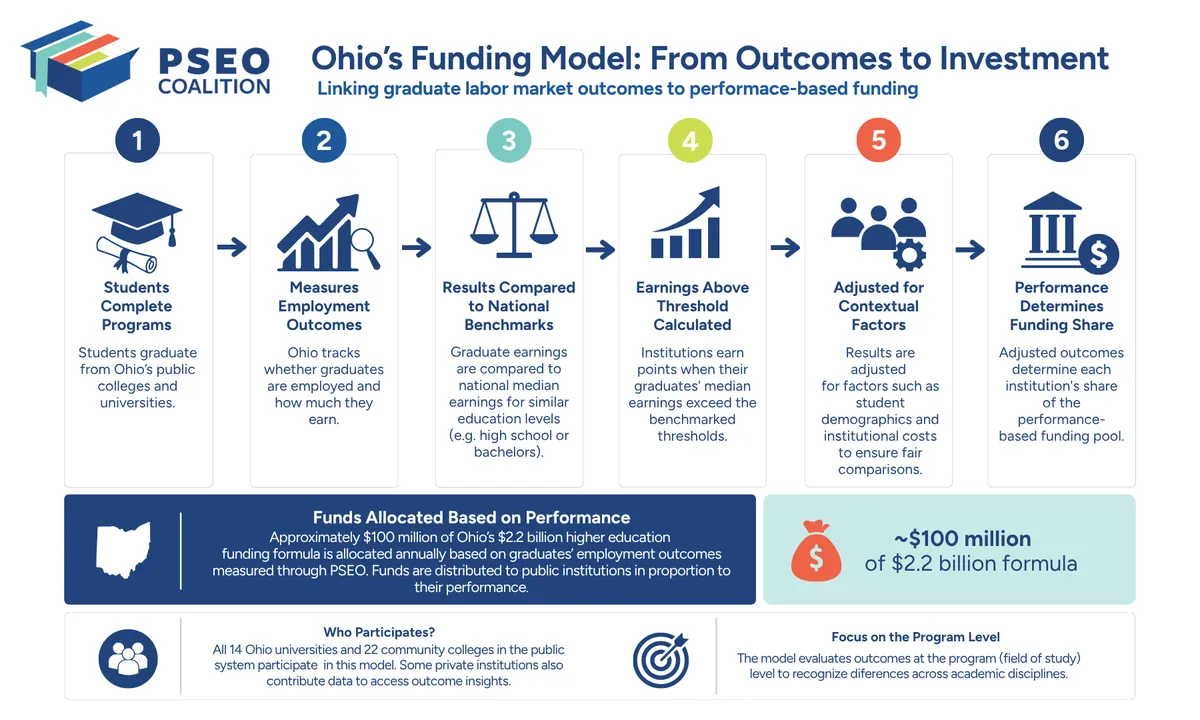
This new perspective enabled Ohio to do something it had been considering since 2018: include post-graduate outcomes directly into its higher education funding formula. Ohio’s higher education funding model is performance-based, meaning the state allocates money to public colleges and universities based on measurable outcomes. Traditionally, these outcomes included metrics such as degrees earned, credits completed, completion of college-level English and Math, and other specialized metrics for graduate study at universities. Under the updated model, and thanks to this more robust data, a portion of funding is now also tied to graduates’ employment outcomes, including employment rates and median post-graduation earnings, as measured through PSEO data. The inclusion of employment outcomes, implemented through Ohio’s state budget process for fiscal years 2026 and 2027, marks a paradigm shift toward a broader definition of student success.
How the Model Works
Today, $100 million of Ohio’s approximately $2.2 billion total higher education funding is allocated based on graduates’ employment outcomes as measured through PSEO data. The employment outcome model assesses both whether graduates are employed and how much they earn, using median earnings to avoid skewing results due to outliers.
Instead of punishing institutions for having lower-earning graduates, the new formula provides incentives when graduates earn above certain thresholds that are benchmarked against Ohio state-level or Metropolitan Statistical Area-level earnings (e.g., median earnings for high school graduates or bachelor’s degree recipients). Importantly, the model evaluates outcomes at the program level by comparing earnings across different fields of study, allowing for a more precise assessment of program performance. Using state data, the model can create meaningful comparisons across different types of programs and institutions, providing institutions with useful information on how effective their programs are. Additionally, the model takes into account contextual factors (e.g., student demographics and institutional costs), acknowledging that factors beyond program effectiveness influence student outcomes.
“We wanted a method that reflected success more broadly,” Church said. “While earnings are not the only result that matters, it is clear that students and families are very concerned about things such as student debt and long-term financial security, and so earnings are certainly an important component of the overall picture.”
The formula applies to Ohio’s public colleges and universities, which all contribute data to PSEO. While some private institutions have also begun participating in PSEO to access similar outcome data, they are not included in the funding model. Ohio’s public system includes 14 universities and 22 community colleges that are funded through this formula.
Building Transparency and Trust
The most difficult challenge in developing the new funding formula was in educating institutions about the availability and use of PSEO data. Using PSEO data differs from traditional models, particularly because it tracks graduates across state lines, relies on median earnings rather than averages, and incorporates state benchmark comparisons. To develop a transparent model that clearly illustrated how an institution could determine its funding based upon PSEO data, Ohio developed detailed Excel workbooks to illustrate all of the formulas used within the model. This allowed each institution to view the exact method used to calculate funding and duplicate the formulas if desired.
This type of transparency into how funding was determined was critical to creating buy-in with each institution. The goal was for each institution to have not only a clear understanding of the amount of funding received from the state, but also how that funding was calculated.
And collaboration has been instrumental in evolving the model, which is periodically revised to address limitations in the data and improve how outcomes are measured. For example, recent discussions have focused on refining how earnings are compared across degree levels and incorporating more precise benchmarks for different fields of study. During these revisions, institutions provide input and help prioritize changes to ensure the model reflects a shared definition of student success.
Early Impact
The new formula was implemented for fiscal year 2026. As with any new policy, it is difficult to judge its impact. However, there are early signs that the PSEO data is providing new insight for Ohio higher education institutions.
Several institutions are now using the PSEO data internally to evaluate program performance and understand how their graduates perform in the workforce. Others are beginning to pose more strategic questions concerning alignment between their educational offerings and labor-market expectations.
Simultaneously, the shift has generated meaningful discussions among stakeholders, including state policymakers, higher education leaders, and institutional administrators. Not all programs are intended to generate substantial income for graduates; some institutions, particularly those focused on preparing students for careers in public service (e.g., teachers), have expressed concern about whether earnings-based metrics accurately represent their missions.
“It has definitely stimulated reflection,” Church said. Institutions are examining what they do, why they do it, and how the outcomes they achieve relate to their purposes.
Looking Ahead
Currently, less than 5% of Ohio’s total funding is allocated based on the PSEO-based portion of the model. However, this signifies a major shift in how Ohio measures its postsecondary education institutions, and the added focus on educational attainment as measured by job-readiness skills and successful placement into a sustainable career after graduation is just the beginning.
Ohio is currently evaluating additional enhancements to improve programmatic assessments at the individual college or university level. The model, as it currently exists, incorporates tuition and fee costs, comparing post-graduation earnings to those costs. But there could be changes to those comparisons in the future, if the institutions reach a consensus that there are better ways to measure costs and to make those comparisons than the ones currently in use. Additionally, as graduate employment is a factor in determining funding increases, colleges and universities may begin to make decisions related to academic programs that influence their potential for employing graduates.
Ohio’s approach to implementing a performance-based model offers insights into how access to improved data can lead to policy shifts that reward the outcomes that matter to students. Meaningful reform requires more than intention; it depends on strong data, collaboration, and a willingness to navigate complex challenges.
